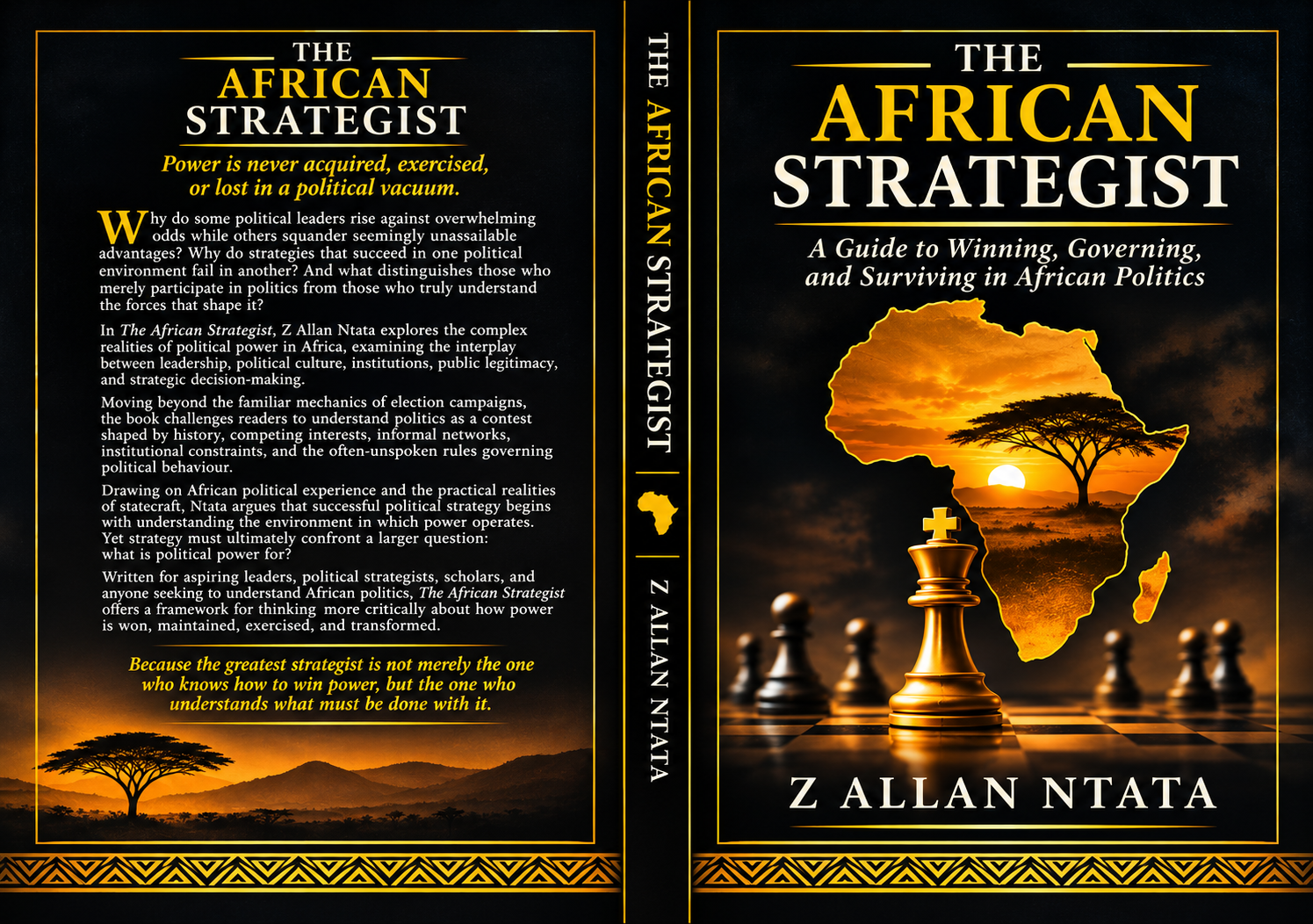
Understanding Power Before Reforming It: Introducing The African Strategist
Understanding Power Before Reforming It: Introducing The African Strategist
A New Publication in Z Allan Ntata’s Continuing Intellectual Inquiry into Political Power, Governance and Legitimacy
By the Africa Politicojuridity Institute (API)
The history of African governance is marked by a recurring paradox. Political leaders and movements have demonstrated remarkable ingenuity in acquiring power, mobilising constituencies, negotiating alliances and overcoming formidable opponents. Yet the capacity to acquire political authority has not always been accompanied by an equivalent capacity to exercise it effectively, govern through durable institutions or translate political victory into sustained national progress.
This paradox raises questions that go beyond the familiar debates about leadership quality, corruption and institutional weakness. What makes political power effective? What determines the strategic choices of those who acquire it? Why do political leaders who demonstrate considerable sophistication in winning elections sometimes struggle to govern? And how does the political environment itself influence the possibilities and limitations of leadership?
These are among the questions explored in The African Strategist: Winning, Governing, and Surviving in the Politics of Power, the newly published book by Z Allan Ntata, founder and director of the Africa Politicojuridity Institute.
Now available on Amazon in Kindle, paperback and hardcover editions, the book represents an important addition to Ntata’s continuing intellectual engagement with African political power. It also complements the Institute’s developing research programme on the relationship between political culture, legal authority, institutional behaviour and governance legitimacy.
Political Strategy Beyond Electoral Victory
Political strategy is frequently understood in terms of electoral competition. The strategist is imagined as the individual who identifies winning messages, constructs coalitions, manages political opponents and develops the tactics necessary to secure public office.
These activities are important, but they represent only one dimension of political strategy. The acquisition of power is not the conclusion of political strategy. It marks a transition into a different strategic environment, one in which the responsibilities of public administration, institutional coordination, economic management and political legitimacy become increasingly consequential.
A political movement may understand how to defeat an incumbent administration without understanding how to manage the institutional arrangements it inherits. A leader may possess considerable popular appeal without appreciating the constraints imposed by public finance, administrative capacity or constitutional accountability. A governing party may demonstrate remarkable skill in preserving political authority while pursuing strategies that gradually undermine the institutions upon which effective governance depends.
These difficulties reveal the limitations of treating political strategy merely as the art of winning elections.
The African Strategist advances a broader conception of political strategy, concerned with the acquisition, exercise and preservation of political power within the particular historical, cultural and institutional environments of African states.
Its underlying proposition is that successful political action requires more than political ambition, organisational strength or tactical ingenuity. It requires an informed understanding of the environment in which political power operates.
The Political Environment as a Strategic Problem
Political power does not operate in an institutional vacuum. It is exercised within environments shaped by historical experiences, political traditions, formal legal arrangements, informal relationships, competing interests and public expectations.
These factors are especially significant in political systems where the formal architecture of constitutional government coexists with deeply embedded informal structures of authority.
Political parties may possess democratic constitutions while remaining organised around powerful personalities. Public institutions may enjoy formal legal independence while facing substantial political pressure. Constitutional rules may prescribe one distribution of authority while established political practices produce another.
For the political strategist, these conditions are not merely background considerations. They form part of the strategic environment itself.
An effective understanding of African politics therefore requires attention to the relationship between formal institutions and the actual processes through which political decisions are made. It requires an appreciation of the incentives influencing political actors, the expectations shaping public behaviour and the historical circumstances through which particular forms of political authority have developed.
This is one reason political strategies cannot always be transferred mechanically from one political environment to another. Approaches that prove effective in one setting may fail elsewhere because they misunderstand the underlying political culture, institutional relationships or sources of authority.
The strategist must consequently be more than a technician of political competition. The strategist must also be an analyst of political systems.
From Political Strategy to the Study of Political Power
The publication of The African Strategist also provides an opportunity to recognise the intellectual continuity within Ntata’s wider body of published work.
His earlier books, including From Democracy to Politicojuridity and Trappings of Power, form part of a sustained engagement with the nature and consequences of political authority.
Although these works approach political power from different perspectives, they are connected by a recurring concern: the relationship between the acquisition of political authority, its practical exercise and the institutional and normative conditions under which that authority operates.
The African Strategist makes the strategic dimension of this inquiry particularly explicit.
It examines political power from the perspective of those seeking to understand, acquire, exercise and sustain it. Its primary concern is the logic of political action and the relationship between strategic choices and political outcomes.
The politicojuridity research programme approaches political power from a different but complementary direction. It investigates what happens when political influence and legal authority become misaligned, particularly where the formal structures of legality continue to exist while their practical operation is increasingly shaped by political interests.
The distinction is important.
Political strategy seeks to understand the choices available to political actors and the conditions influencing their effectiveness. Politicojuridity examines the relationship between political power and the legal and normative restraints through which that power is supposed to be governed.
One is principally concerned with the strategic operation of political power; the other with its relationship to legality, legitimacy and accountability.
Yet the two inquiries inevitably intersect.
A political strategy that fails to understand the institutional and cultural environment in which power operates is likely to misjudge the conditions of political effectiveness. Equally, an account of governance failure that overlooks the strategic incentives of political actors may struggle to explain why institutions repeatedly behave in ways that appear inconsistent with their formal mandates.
Understanding political power and understanding the constraints upon it are therefore related intellectual tasks.
The Intellectual Foundations of API
The Africa Politicojuridity Institute was established to advance research into the relationship between political power, legal culture and governance legitimacy, with particular attention to African political systems.
Its central theoretical concern is the possibility that governance failures cannot always be adequately explained through deficiencies in institutional design, administrative capacity or the formal legal framework.
Institutions may exist, constitutional provisions may remain intact, and accountability mechanisms may be formally available, while the actual operation of political power determines whether those mechanisms can function as intended.
Politicojuridity provides a conceptual framework for examining this relationship.
At its core is the proposition that the effectiveness of legal and governance institutions depends not merely upon their formal existence, but also upon the relationship between the political culture within which they operate and the legal culture they are intended to sustain.
Where political influence consistently overrides legal restraint, the resulting misalignment may allow the preservation of constitutional and institutional forms without the corresponding realisation of substantive accountability.
This approach has important implications for the study of corruption, constitutionalism, democratic legitimacy and governance reform.
It also suggests that the study of political power should not be confined to the question of whether particular leaders possess the political will to implement reforms. Researchers must also investigate the incentives, institutional relationships and political practices through which power influences the operation of legal restraints.
Within this broader intellectual programme, The African Strategist contributes a complementary perspective by directing attention to the strategic reasoning and political environments through which political actors pursue their objectives.
The book is not presented as a substitute for the Institute’s research into Politicojuridity, nor should its strategic analysis be confused with the normative evaluation of political legitimacy. Rather, it belongs to a developing body of thought in which political strategy, institutional analysis and governance philosophy inform one another.
Why Africa Needs a More Serious Conversation About Strategy
The challenges confronting African governance are frequently discussed in terms of leadership failure. Public debate often concentrates on the qualities of individual political leaders, the promises they make, the alliances they construct and the decisions they take once in office.
These questions matter. But they can obscure a more fundamental issue: whether political actors and the institutions surrounding them possess an adequate understanding of the strategic conditions necessary for effective governance.
The distinction between political success and governing success is particularly important.
Electoral victory may demonstrate that a political organisation has successfully mobilised support. It does not necessarily demonstrate that the organisation possesses a coherent understanding of the state, the economy, public administration or the institutional constraints within which its policies must operate.
Similarly, political survival may demonstrate that a governing administration has successfully managed competing interests and preserved its authority. It does not necessarily establish that its strategies have strengthened public institutions or advanced the longer-term interests of the population.
A serious conception of political strategy must therefore extend beyond the immediate interests of political officeholders.
It must address the relationship between political decisions and institutional consequences, between short-term political advantage and long-term public outcomes, and between the preservation of political authority and the maintenance of legitimate governance.
This is not an argument against political competition. It is an argument for understanding political competition within the wider responsibilities of political leadership.
Africa requires political actors who understand not only how power can be won, but also the institutional and social conditions under which its exercise can produce meaningful public benefit.
Building an African Intellectual Conversation About Power
The publication of The African Strategist comes at an important stage in the development of the Africa Politicojuridity Institute.
As API expands its research agenda, an important objective is to encourage sustained intellectual engagement with the relationship between political authority, institutional behaviour and governance outcomes.
This requires more than commentary on individual political events. It requires the development of conceptual frameworks, historically informed analysis, comparative research and opportunities for critical scholarly debate.
Books have an important role in this process. They allow arguments to be developed beyond the limitations of immediate political commentary and provide a basis upon which scholars, practitioners and citizens can engage with ideas over time.
The publication of The African Strategist, alongside Ntata’s earlier works and continuing research on Politicojuridity, contributes to the development of a recognisable intellectual programme concerned with political power in Africa.
That programme is organised around three related questions.
First, how is political power acquired, exercised and preserved within African political environments?
Second, why does political power sometimes escape or neutralise the legal and institutional constraints intended to regulate it?
Third, what political, legal and normative conditions are necessary to ensure that the exercise of public authority remains legitimate, accountable and productive?
These questions are distinct, but their answers cannot be entirely separated.
A sophisticated understanding of governance requires an understanding of political power. An adequate understanding of political power requires attention to the institutions and political cultures within which it operates. And any serious programme of governance reform must confront the relationship between the strategic interests of political actors and the legal and moral obligations of public authority.
It is at this intersection that API seeks to contribute to African governance scholarship and public policy debate.
A Book, and a Continuing Intellectual Project
The African Strategist is written for political practitioners, aspiring leaders, researchers, students and readers interested in the deeper workings of African political systems.
Its significance lies not merely in its treatment of electoral competition or political leadership, but in its invitation to examine political strategy as a broader intellectual and practical discipline.
For political practitioners, it encourages reflection on the difference between tactical success and strategic effectiveness. For scholars and students, it provides a perspective from which to examine the relationship between political culture, institutional arrangements and political behaviour. For citizens, it invites a more demanding understanding of leadership and the responsibilities associated with public power.
For the Africa Politicojuridity Institute, the book also represents another contribution to the continuing effort to understand political power as a central problem of African governance.
The argument underlying this intellectual project is that Africa’s governance challenges cannot be resolved merely by changing the individuals who occupy political office, nor by assuming that the existence of constitutional institutions guarantees their effective operation.
Political power must be understood before its behaviour can be adequately explained. Its relationship with legal and institutional restraints must be examined before governance failures can be properly diagnosed. And its strategic incentives must be taken seriously if reforms are to produce more than formal changes in institutional design.
The future of African governance will depend, in part, upon the quality of this understanding.
The greatest strategist is not merely the one who knows how to win power, but the one who understands what must be done with it.
That proposition captures the central invitation of The African Strategist. It also points toward the larger intellectual undertaking to which the book contributes: understanding political power, examining its relationship with legitimacy, and exploring the conditions under which it can serve the public good.
About the Book
Title: The African Strategist: Winning, Governing, and Surviving in the Politics of Power
Author: Z Allan Ntata
Formats: Kindle eBook, Paperback and Hardcover
Availability: Amazon
About the Author
Z Allan Ntata is a barrister, political strategist, governance researcher and founder-director of the Africa Politicojuridity Institute. A former Presidential Legal Counsel in Malawi, he has worked at the intersection of political strategy, legal institutions and public governance. His intellectual work examines the acquisition, exercise and legitimacy of political power, with particular emphasis on African political systems.
About the Africa Politicojuridity Institute
The Africa Politicojuridity Institute (API) is a governance research and policy institution dedicated to investigating the relationship between political power, legal culture, institutional accountability and legitimacy in Africa. Its work seeks to develop theoretical and practical approaches to understanding governance failures and strengthening the conditions for legitimate public authority.