
The Africa Politicojuridity Institute (API) is an independent research and policy institute dedicated to advancing the philosophical, theoretical and practical foundations of legitimate, accountable and developmental governance in Africa.
API proceeds from the conviction that Africa’s persistent governance challenges require more than changes in political leadership, institutional strengthening or the repeated adoption of internationally prescribed governance reforms. They warrant a fundamental reconsideration of the assumptions upon which public authority is constituted, exercised, justified and constrained.
The Institute was established to provide an intellectual environment in which these assumptions can themselves become legitimate objects of inquiry, and in which alternative approaches to governance can be developed through rigorous scholarship, empirical investigation and contextually grounded constitutional innovation.
Although Africa provides the historical and intellectual impetus for our work, the questions we investigate concern the nature of legitimate public authority everywhere
Our Intellectual Departure
For decades, governance interventions across Africa have been substantially informed by the assumption that legal-rational democratisation and institutionalisation represent the ultimate destination of political development. Yet the persistence of corruption, constitutional subordination, institutional dysfunction and developmental failure, even where extensive legal and institutional reforms have been undertaken, raises a fundamental question:
What if the problem lies not merely in the failure to implement the prevailing governance architecture, but also in the architecture itself?
API does not reject democracy, constitutionalism or the rule of law. Rather, it interrogates the philosophical and normative foundations upon which their institutional expression has been constructed. We recognise that political authority operates within historically constituted normative environments. Legal institutions do not enter normatively empty societies. They encounter existing understandings of authority, obligation, justice, stewardship, accountability and political legitimacy.
Where these normative realities are inadequately reconciled with the formal constitutional order, governance institutions may retain their legal form while their substantive purposes become subordinated to competing interests and claims to authority.
Understanding and addressing this condition lies at the heart of API’s intellectual enterprise.
Politicojuridity: Our Analytical Framework
Politicojuridity is an interdisciplinary framework for understanding the relationship between political power, legal authority and normative legitimacy.
Through its central conceptual model, the Authority Triangle, Politicojuridity examines how these three dimensions of public authority interact, reinforce one another or fall into misalignment.
The Principle of Normative Balance provides the governing standard against which these relationships are assessed. Where political power, legal authority and normative legitimacy become substantively misaligned, a condition of Politicojuridical Rupture may emerge.
The framework investigates not only the existence of such misalignment but also the mechanisms through which it is produced, sustained and reproduced. These include the Illegitimate Governance Loop, which examines the self-reproduction of governance dysfunction; Politicised Service Rationality, which investigates how institutional actors adapt their conduct to prevailing political conditions; and the Universalistic Governance Reproduction Loop, which examines how the structural incentives of the international and domestic governance ecosystem may perpetuate reform approaches that leave underlying governance pathologies unresolved.
Through these constructs, API seeks to move governance scholarship beyond the description of institutional failure towards an explanation of its production and persistence.
Normative Rationalism: Our Governance Philosophy
Diagnosis alone is insufficient. Understanding why governance systems fail does not necessarily establish how they ought to be reconstructed.
API advances Normative Rationalism as a philosophy of legitimate authority that proceeds through the identification and critical evaluation of the prevailing normative claims of a polity, and the incorporation of rationally defensible claims into the constitutional organisation of public authority in accordance with the Principle of Normative Balance.
Normative Rationalism challenges the presumption that any particular institutional model possesses universal normative supremacy independently of the historical and social environment in which it operates.
It does not advocate the accommodation of corruption, patronage, nepotism or arbitrary political authority. Nor does it presume that established cultural practices are legitimate merely because they are socially prevalent or historically embedded. Its purpose is to distinguish legitimate normative claims from their potentially pathological manifestations and to investigate how those claims might find accountable constitutional expression.
Through the Normative Rationalist Cascade, API translates this philosophical orientation into a structured process of normative identification, normative evaluation, constitutional integration and politicojuridical assessment.
The objective is not to constitutionalise existing governance practices. It is to constitute legitimate public authority rationally.
Reconstitutionalisation: Our Approach to Structural Intervention
Where empirical investigation establishes that the constitutional organisation of public authority contributes to the persistent reproduction of governance dysfunction, API advances Reconstitutionalisation as a potential structural intervention. Reconstitutionalisation involves the deliberate reconsideration and reconstruction of the distribution, obligations, relationships and constraints of public authority, informed by legitimate normative claims and governed by the Principle of Normative Balance. It extends the scope of governance reform beyond improving the performance of existing institutions to examining whether the relationships of authority within which those institutions operate require transformation.
Reconstitutionalisation does not necessarily entail replacing an entire written constitution. It may involve constitutional amendments, institutional redesign, the redistribution of public authority, the reconstruction of accountability relationships or the development of alternative arrangements for public participation and governance. The appropriate intervention must emerge from empirical and philosophical inquiry rather than from a predetermined institutional destination.
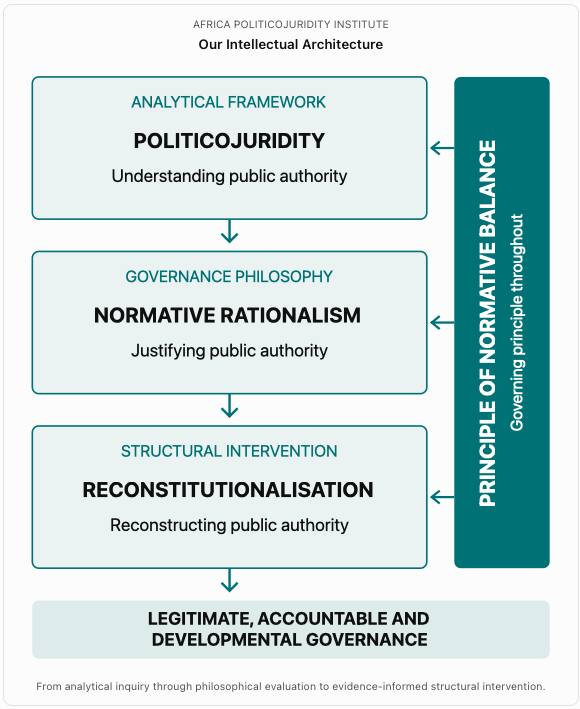
Politicojuridity investigates the constitution of authority. Normative Rationalism interrogates its justification. Reconstitutionalisation reconstructs its architecture. Normative Balance governs them all.
Our Intellectual Architecture
API’s research programme brings together a coherent and developing architecture of philosophical principles, theoretical constructs, empirical methods, diagnostic instruments and structural interventions.
| Intellectual component | API construct |
| Analytical framework | Politicojuridity |
| Conceptual model | Authority Triangle |
| Governing principle | Principle of Normative Balance |
| Structural pathology | Politicojuridical Rupture |
| Domestic reproduction mechanism | Illegitimate Governance Loop |
| Actor-level mechanism | Politicised Service Rationality |
| International reform reproduction mechanism | Universalistic Governance Reproduction Loop |
| Governance philosophy | Normative Rationalism |
| Research methodology | Constraint Tracing |
| Diagnostic instrument | Africa Governance Index |
| Reconstructive process | Normative Rationalist Cascade |
| Structural intervention | Reconstitutionalisation |
These components constitute an integrated research programme through which API seeks to understand governance dysfunction, investigate its underlying mechanisms, evaluate the normative foundations of public authority and develop evidence-informed approaches to governance reconstruction.
The architecture remains open to scholarly criticism, empirical testing, refinement and further theoretical development.
From Scholarship to Intervention
API is committed to bridging the distance between governance scholarship and governance practice. Through Constraint Tracing, the Institute investigates the practical consequentiality of legal and constitutional restraints upon political power, examining the institutional decisions, political pressures and normative claims through which accountability is sustained or undermined.
Through the Africa Governance Index (AGI), API is developing an alternative approach to governance assessment that recognises the interdependence of poverty, culture, constitutional and institutional arrangements, literacy and the media. The AGI seeks to move beyond assessing how closely a polity conforms to a preferred institutional model towards investigating how effectively its organisation of public authority produces legitimate, accountable and developmental governance.
Our work encompasses foundational theoretical scholarship, comparative governance research, constitutional analysis, policy development, governance diagnostics, public education, institutional capacity building and engagement with policymakers, civil society and development partners.
API’s ambition is not merely to explain Africa’s governance challenges. It is to contribute to the intellectual and practical conditions necessary for addressing them.

Our Commitment to Intellectual Independence
API recognises that the advancement of knowledge requires rigorous inquiry, intellectual accountability and openness to scholarly criticism. We do not, however, regard conformity with prevailing intellectual paradigms or prior acceptance by established publication institutions as prerequisites for the dissemination of scholarly contributions. Where prevailing governance frameworks themselves constitute the object of critical inquiry, intellectual independence becomes particularly important.
Through its Foundational Theoretical Paper Series and other research publications, API is committed to the timely dissemination of theoretically grounded scholarship, the transparent identification of propositions requiring empirical validation and the continuing refinement of its contributions through research, scholarly engagement and practical evaluation.
Agreement with Politicojuridity is not a condition of intellectual engagement with the Institute. We welcome scholars, practitioners and institutions willing to interrogate both established governance paradigms and the alternative propositions advanced by API.
The Institute must be a home for intellectual inquiry, not a sanctuary for intellectual agreement.
The Africa Politicojuridity Institute exists to contribute to that endeavour.
We believe that the future of African governance need not be confined to the institutional possibilities of the past.
We imagine how African governance could be.
We investigate why it is not.
We explore how it can become so.